

This changelog is the source of truth for all changes to the Jira Hooks for Bitbucket Cloud that affect people using the Addon.
IMPROVEMENT Improved performance
Improved the overall performance of the validation process to provide faster and more responsive feedback during pull request checks. This enhancement reduces waiting times, especially for larger repositories and complex validation configurations, resulting in a smoother and more efficient review workflow.
New Feature Statistics and analytics dashboard
We’ve introduced a new Statistics and analytics page to give you better visibility into how Jira Hooks for Bitbucket is used across your workspace.
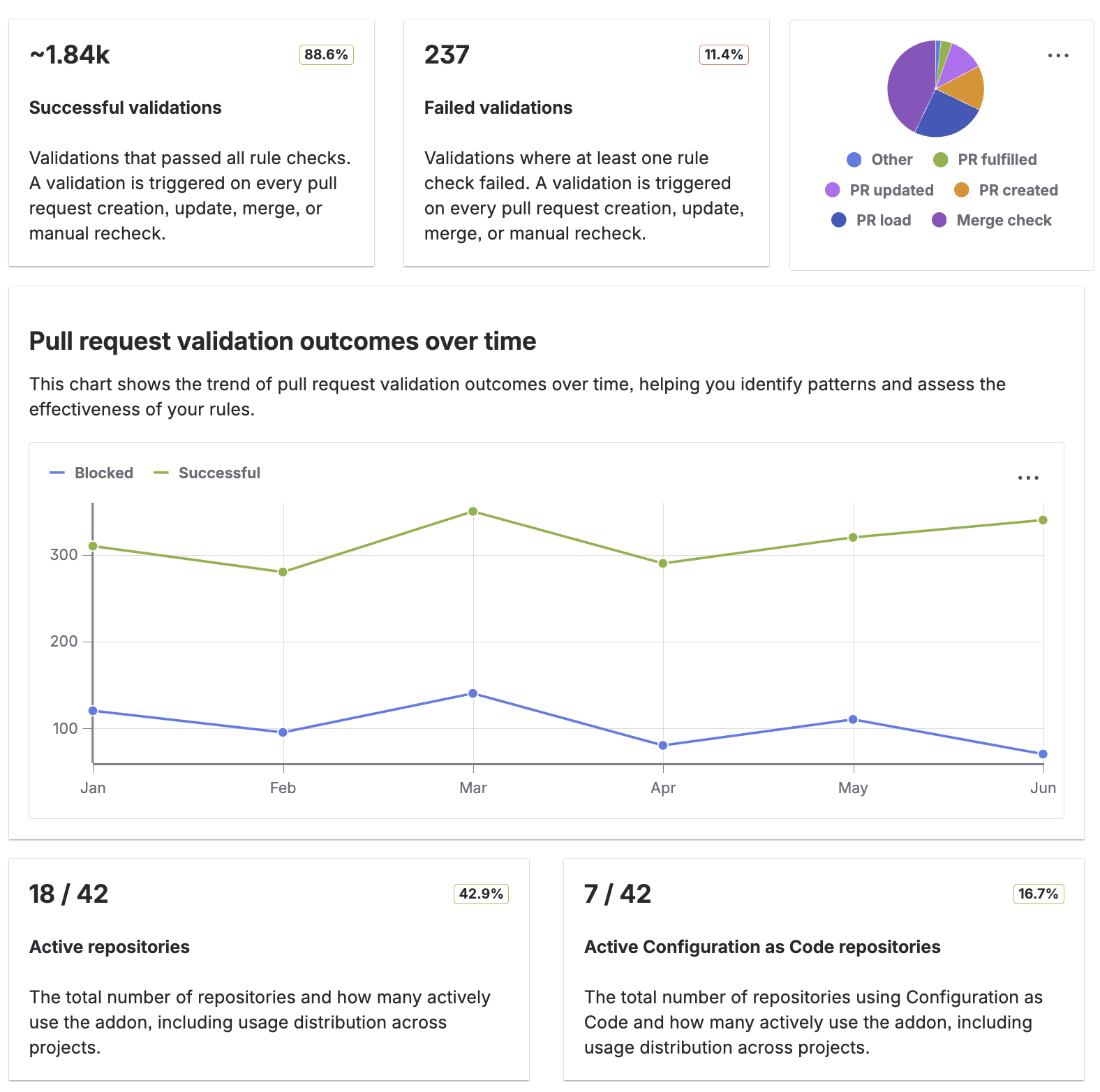
With this update, you can:
-
track successful and failed validations
-
analyze validation trends over time
-
monitor repository adoption and Configuration as Code usage
These insights help you understand rule effectiveness, identify patterns, and continuously improve your compliance setup.
New Feature Process Guardian
We’ve enhanced the existing rule engine with the introduction of the Process Guardian.
While rules and validations were already available, the Process Guardian now actively enforces them at the pull request level. Based on the validation result, it can:
-
approve pull requests when all rules are satisfied
-
reject pull requests (veto) when compliance requirements are not met
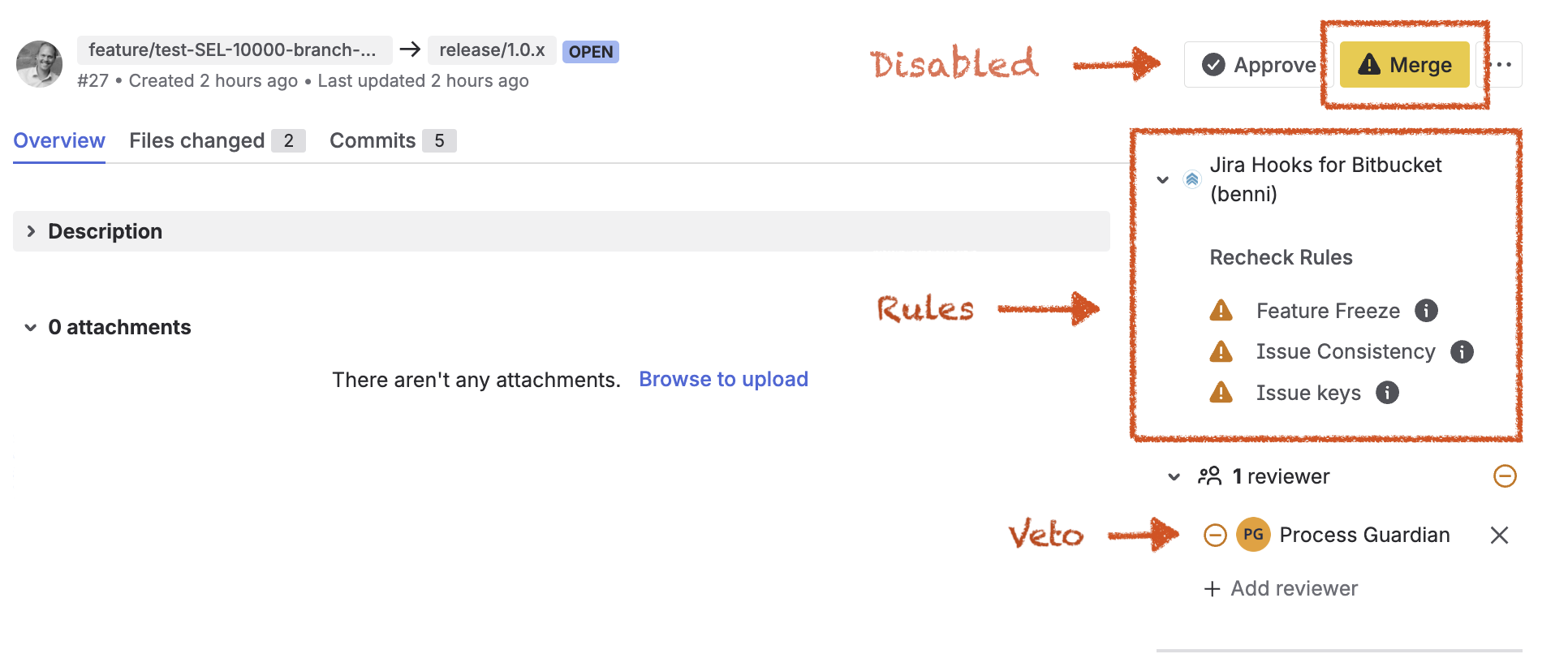
This means that rule validation is no longer limited to custom merge checks. It can now also be enforced directly through the standard merge requirement “No changes are requested” in the “Branch restrictions”. The validation is executed when the pull request page is loaded, ensuring that the merge state is updated before a merge is attempted.
Additional benefits:
-
immediate feedback directly on the pull request
-
automatic notifications when a veto is applied
-
improved visibility and faster resolution of compliance issues
This update turns the rule engine into an active enforcement mechanism and strengthens compliance across your development workflow.
The merge check is still required for the final validation and should continue to be configured. This new capability is primarily a convenience feature that provides earlier feedback and visibility, but it does not replace the final merge-time validation.
New Feature Detailed pull request validation view
We’ve enhanced the pull request detail view with more granular validation insights.
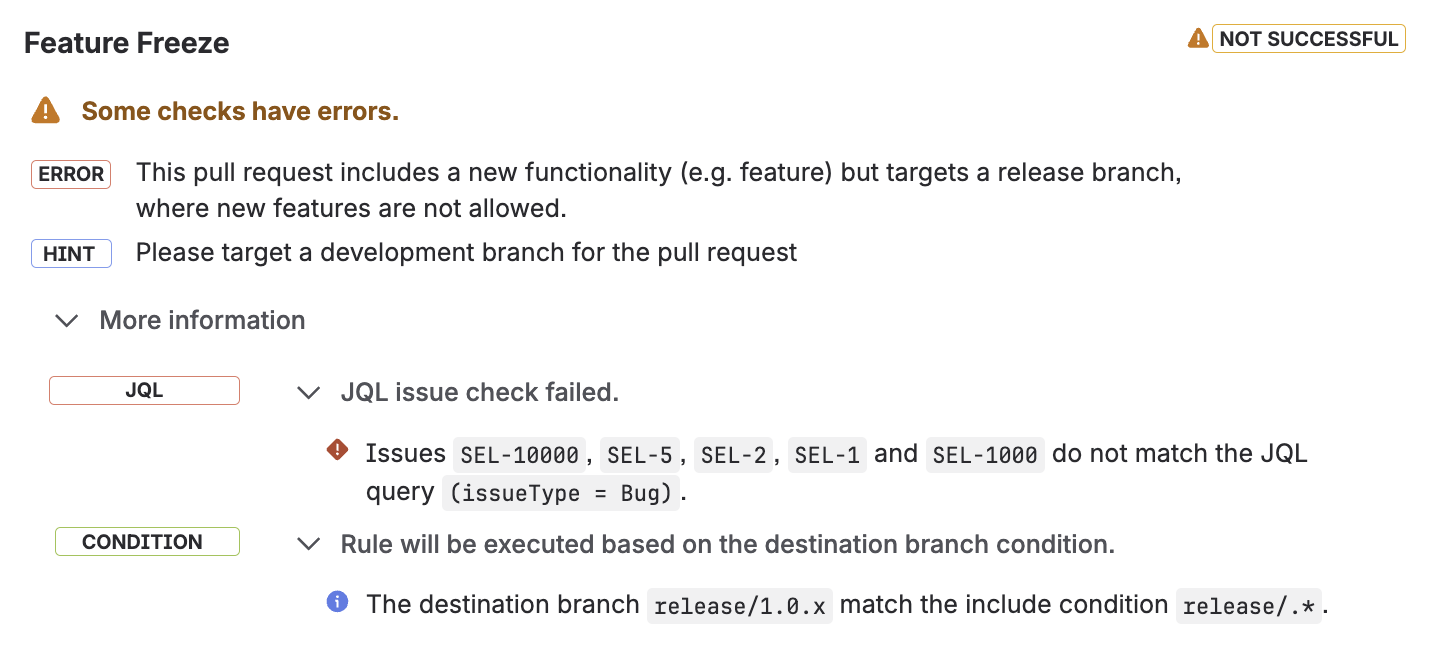
You can now see detailed information about:
-
all associated checks, including their individual status
-
the exact reasons why a check passed or failed
-
evaluated conditions and why a rule was applied
These details are not only displayed in the pull request view but are also persisted with the pull request, providing a complete and traceable validation history.
This improves:
-
transparency for developers
-
faster root cause analysis
-
stronger auditability for compliance requirements
The enhanced view helps you understand validation results at a glance and drill down into the exact cause of issues directly within the pull request.
New Feature Persistent pull request validation history
Validation results are now stored permanently on the pull request. This means that even after a pull request has already been merged, the rules and validation results from the point in time of the merge remain available. Teams can therefore still review which rules were evaluated and why the pull request was allowed to be integrated. This significantly improves the audit trail by creating a durable validation record directly on the pull request.
Benefits include:
-
access to validation results even after merge
-
clear traceability of rule outcomes at merge time
-
improved support for compliance reviews and audits
This feature turns the pull request into a persistent compliance record and makes validation outcomes available long after the merge has completed.
New Feature Configuration as Code (CaC)
We’ve introduced Configuration as Code (CaC), allowing you to define and manage your rules directly in your repository using YAML.
With this feature, rule configurations are version-controlled and can be maintained alongside your code. Each branch can define its own set of rules, enabling flexible and context-specific validation.
Key capabilities:
-
define rules using a YAML configuration file
-
manage rule changes through pull requests and version control
-
support branch-specific rule configurations
-
optionally combine CaC with existing workspace rules using hybrid mode
This approach provides:
-
improved transparency and traceability of rule changes
-
better collaboration through code review processes
-
consistent and reproducible configurations across repositories
Configuration as Code enables a more scalable and developer-friendly way to manage compliance rules.
New Feature Redesigned settings UI with improved DX
Redesigned the settings interface to improve the overall developer experience with a cleaner layout, better navigation, and a more intuitive configuration flow. The updated UI makes it easier to manage validation rules and system settings, helping teams configure and maintain Jira Hooks for Bitbucket more efficiently.
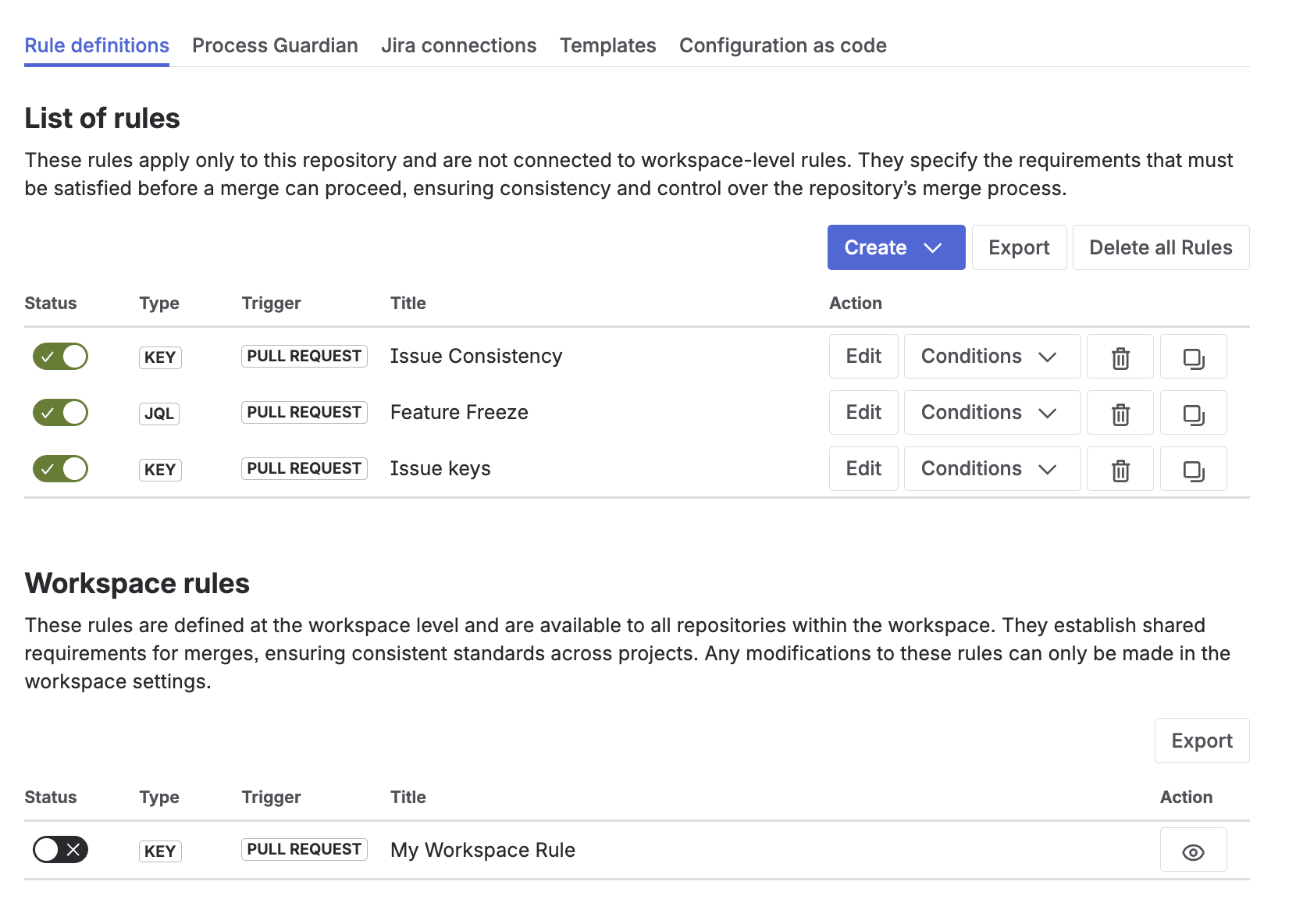
Rules can now be created based on their check type, for example:
-
Issue
-
Naming convention
-
Generic
Each rule can also be assigned to a trigger, which defines when the rule is evaluated. At the moment, only the pull request trigger is supported. Additional triggers will be introduced in future releases.
Rules can now also be extended with conditions to control when they apply. This makes it possible to configure rule execution more precisely, for example for specific pull request flows or branch patterns.
This update provides:
-
a clearer and more intuitive rule creation flow
-
better separation of checks, triggers, and conditions
-
more precise control over rule execution
-
a stronger foundation for future rule and trigger types
The new UI makes it easier to create, understand, and maintain compliance rules across your repositories.
New Feature Local commit and push validation with simplified setup
Added support for local commit and push validation checks, enabling rules to be evaluated before commits are created and before changes are pushed to a remote repository. The new Python-based hook implementation provides a simple installation process with minimal configuration, making it easy for teams to adopt local compliance and quality checks. By shifting validation earlier in the development workflow, developers receive faster feedback, reduce rework, and prevent issues from reaching shared repositories and pull requests.
Check it out:
-
https://bitbucket.org/devopssystems-public/jira-hooks-for-bitbucket-githooks -
https://github.com/devopssystems/Jira-Hooks-for-Bitbucket-Git-Hooks
For a detailed overview of code changes, improvements, and fixes across all releases, visit our changelog.