

Conditions define when a rule applies. They act as a filter before any validation starts. A rule is only evaluated when its trigger fires and all configured conditions are satisfied. This allows teams to apply rules selectively based on context, such as branch patterns.
Conditions can be added to an existing rule to control in which situations that rule should be evaluated.
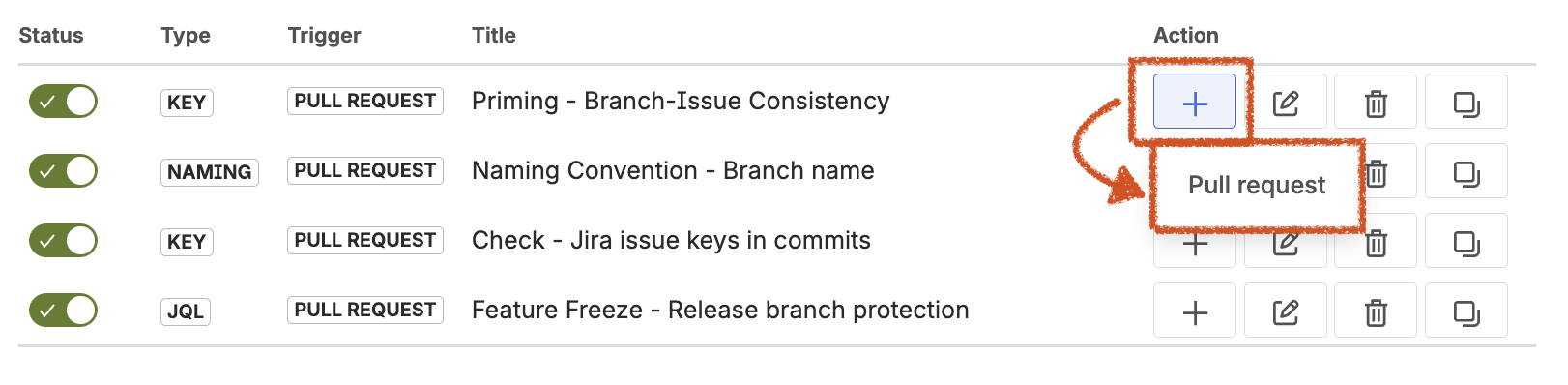
Pull request condition
The pull request condition controls whether a rule applies based on pull request information.
It is used to restrict rule execution to specific pull request flows by evaluating the destination branch. This makes it possible to target rules to defined integration paths, such as merges into release branches, main branches, or other controlled target branches. By applying rules only where they are relevant, the pull request condition helps reduce unnecessary validations and supports more precise compliance enforcement.
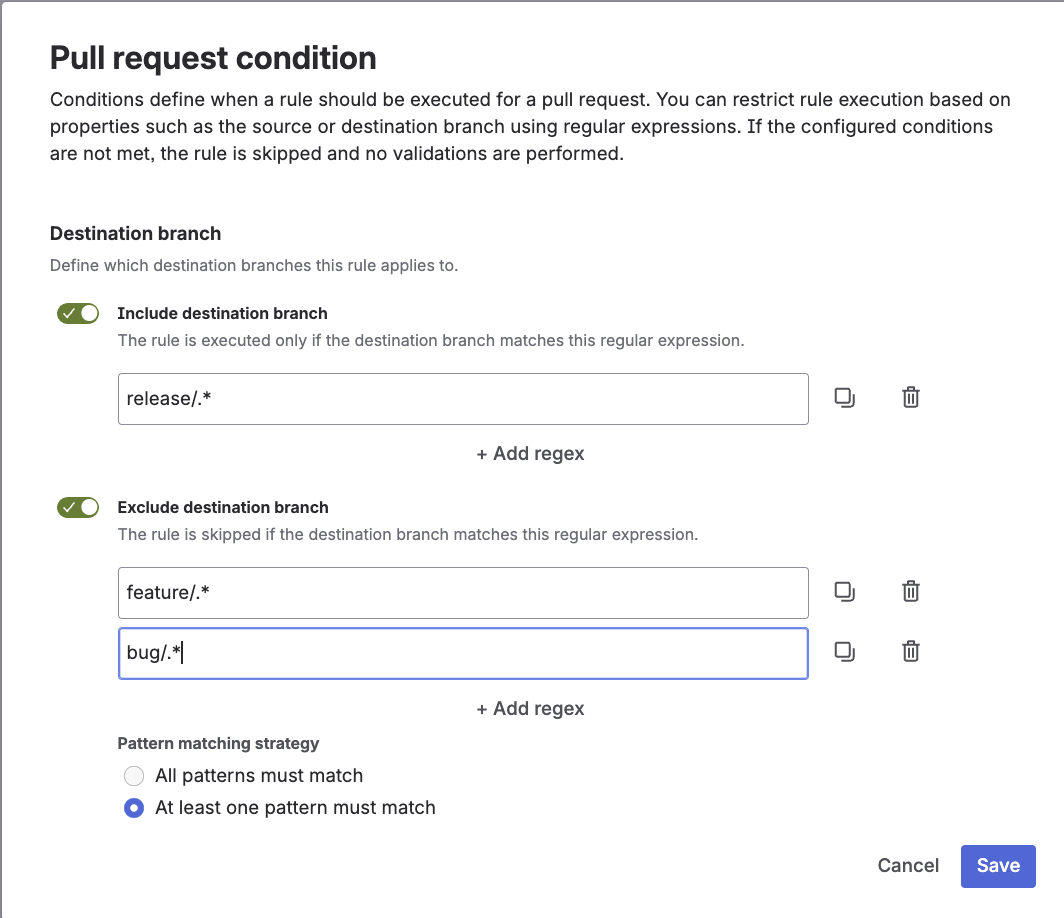
Configuration options
|
Option name |
Description |
Values |
|---|---|---|
|
Destination branch |
Defines conditions for the pull request target branch. |
|
Branch condition
The branch condition controls whether a rule applies based on the current branch name.
It is used to restrict rule execution to specific branches by evaluating the branch against configured include and exclude patterns. This makes it possible to target rules to defined branch types, such as feature branches, bugfix branches, release branches, or other repository-specific workflows.
By applying rules only where they are relevant, the branch condition reduces unnecessary validations and enables more precise compliance enforcement.
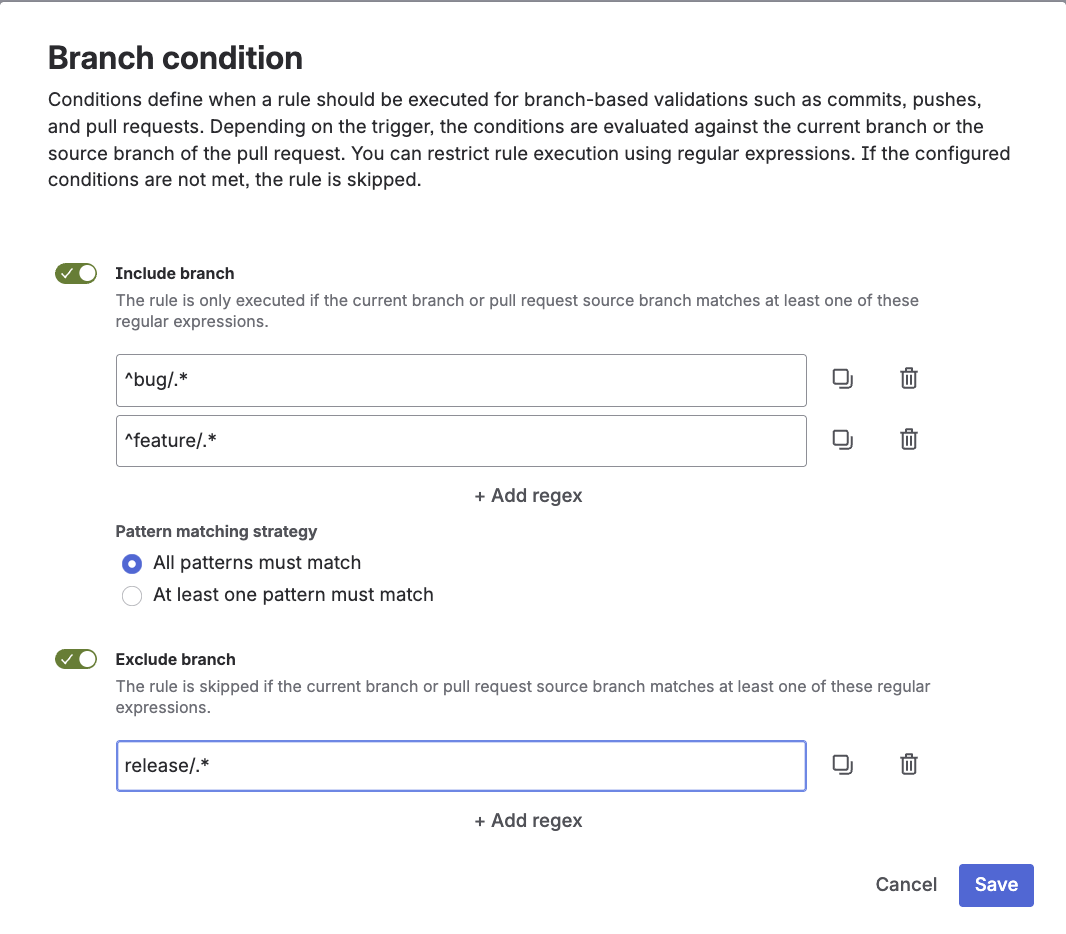
The branch condition is evaluated for Commit, Push, and Pull Request validations. The branch that is evaluated depends on the trigger and context:
-
For Commit validations, the current branch is evaluated.
-
For Push validations, the branch being pushed is evaluated.
-
For Pull Request validations, the branch condition is evaluated against the source branch of the pull request.
As a result, the same branch condition can be reused consistently across different stages of the development workflow.
|
Option name |
Description |
Values |
|---|---|---|
|
Branch |
Defines conditions for the pull request source branch. |
|
Pattern matching strategy
Each include and exclude condition can contain one or multiple regular expressions. If multiple include patterns are configured, the pattern matching strategy defines whether:
-
All patterns must match
-
At least one pattern must match
Examples:
|
Branch |
Destination branch |
Result Push |
Result Pull |
|---|---|---|---|
|
feature/login |
release/1.0.x |
Executed Branch does match the configured include pattern (feature/.*) |
Executed Source branch matches an include pattern (^feature/.*) and destination branch matches an include pattern (release/.*). |
|
bug/login |
release/1.0.x |
Executed Branch does match the configured include pattern (bug/.*) |
Executed Source branch matches an include pattern (^bug/.*) and destination branch matches an include pattern (release/.*). |
|
feature/login |
feature/backend |
Executed Branch does match the configured include pattern (feature/.*) |
Skipped Destination branch matches an exclude pattern (feature/.*). (at least one) |
|
feature/login |
bug/backend |
Executed Branch does match the configured include pattern (feature/.*) |
Skipped Destination branch matches an exclude pattern (bug/.*). (at least one) |
|
release/1.0.x |
release/1.0.x |
Skipped Branch does match the configured exclude pattern (release/.*). |
Skipped Source branch matches an exclude pattern (release/.*) |
|
feature/login |
main |
Executed Branch does match the configured include pattern (feature/.*) |
Skipped Destination branch does not match the configured include pattern (release/.*). |
|
develop |
release/1.0.x |
Skipped Branch does not match the configured include pattern
|
Skipped Source branch does not match any configured include pattern
|
Key takeaway
The pull request condition allows rules to be applied selectively based on source and target branch patterns.
Extensibility
The condition model is designed to support additional condition types in the future.